


Focus Areas
PROGRAMS
TRAINING
RESEARCH
“The use of sound behavioral assessment and intervention practices in a school setting puts Turning Pointe Autism Foundation among the elite school-based programs in the country.”
TIMOTHY VOLLMER, PH.D., BCBA-D, UNIVERSITY OF FLORIDA
PROGRAMS
TRAINING
RESEARCH
Research

RESEARCH & INNOVATION INFORM DAILY PRACTICE
From the earliest days, the Wolf family encouraged Turning Pointe to leave behind old models and focus on what it really takes to make an impact for each person.
With this charge, a precedent was set to prioritize research, continual learning, and the freedom granted to honor the wondrous complexity of autism neurodiversity. Our interdisciplinary model of care centers on meeting each individual's unique needs.
Today, Turning Pointe is an experienced autism learning facility that conducts and publishes behavioral research. Our commitment to best-practice, evidence-informed programs allows us to advance the field of autism research and integrate cutting-edge research into daily work immediately.
Guided by a national expert Practice Advisory Board, Turning Pointe participates in behavioral research, data collection, academic conferences, and research publication.
RESEARCH IN ACTION
Improving Autism Early Detection
Netherlands-based BlinkLab collaborated with Turning Pointe on the development of AI software to boost early detection. The software measures eye gaze, stimuli, and reflexive responses and will be made available to clinicians via mobile app. Currently under FDA review.
Paraeducator Training Approach Helps Students Initiate AAC Communication
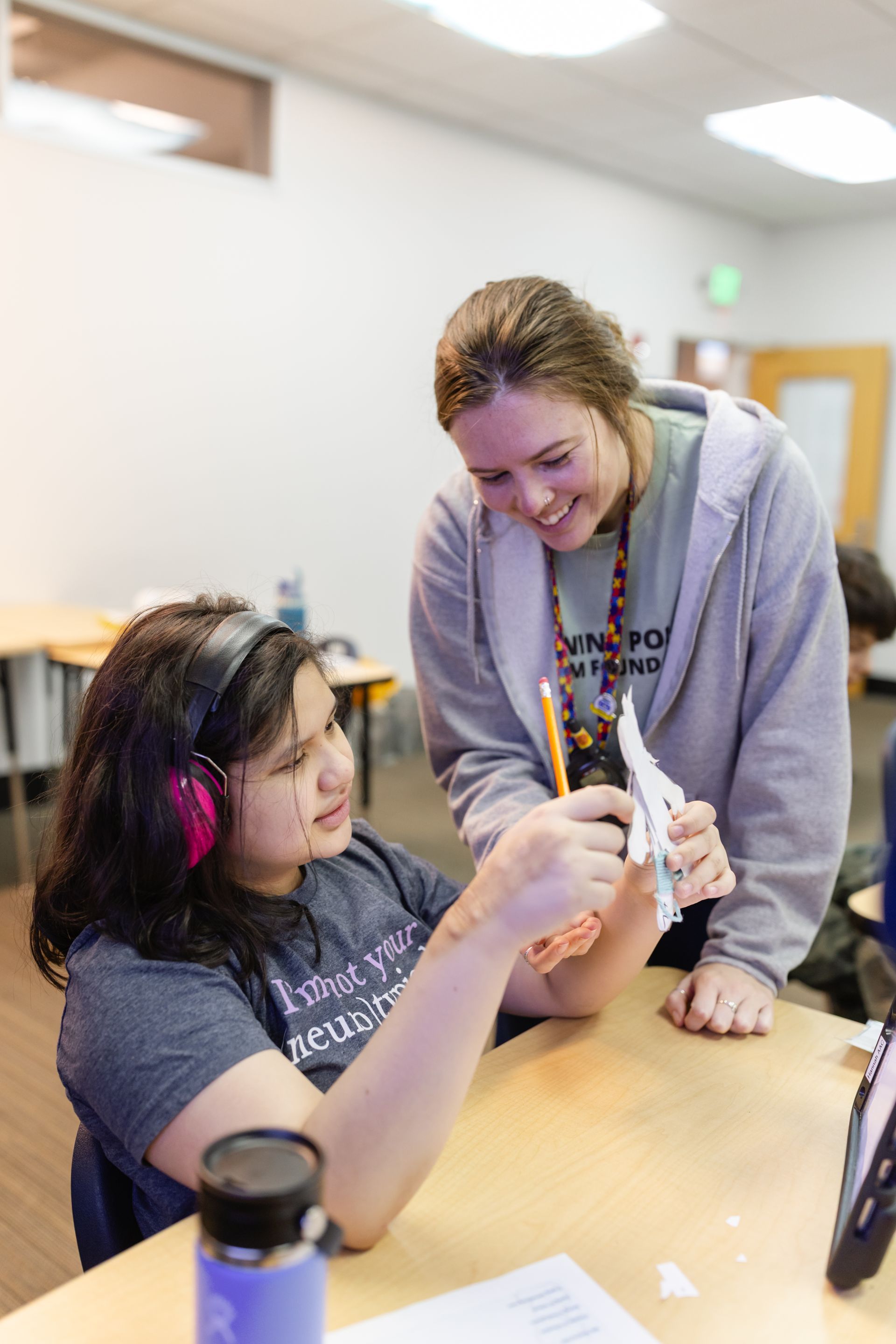
The ability to initiate communication is a critical skill for individuals who use augmentative and alternative communication (AAC) systems. Individuals who are more impacted by their autism (level 3) may face additional challenges in developing this skill. Led by Dr. Natalie Andzik at Northern Illinois University, Turning Pointe facilitated a study examining a paraeducator training approach designed to better support these students. The findings showed that paraeducators can effectively increase communication initiation; however, consistent outcomes were closely linked to staff stability and familiarity with students’ communication devices.
Understanding Stereotypy and AAC
Using Augmentative and Alternative Communication systems (AAC), such as iPads, can transform how autistic people communicate with the world. Turning Pointe set out to understand why AAC-related stereotypy occurs and whether it affects communication and learning.
RESEARCH PUBLICATIONS & PRESENTATIONS
Click here to access our list of published manuscripts and presentations.
PROFESSIONAL TRAINING & Certifications
Institutional Review Board (IRB) Approval
All research conducted through Turning Pointe Autism Foundation is reviewed and approved by an Institutional Review Board (IRB), an independent committee that ensures that studies are ethical, protect participants' rights, and follow federal research standards.
Turning Pointe currently maintains IRB approval through Northern Illinois University (NIU) and actively collaborates with research partners at Louisiana State University (LSU) and Princeton University, who operate under their own institutional IRB oversight. These partnerships help ensure our research meets rigorous academic and ethical standards while contributing to meaningful, real-world outcomes for students and schools.
Additional Certifications:
International Board of Credentialing and Continuing Education Standards (IBCCES) Certified Autism Center
Accredited by the Commission on Accreditation of Rehabilitation Facilities (CARF)
A National Association of Special Education Teachers (NASET) School of Excellence
Authorized Continuing Education (ACE) Provider by the Behavior Analyst Certification Board
All programs align with recognized evidence-based practices, including National Standards for Evidence-Based Treatment (NSET)